
Unlike DiGA, digital care applications (DiPA) have had a hard time so far: for want of successful approvals, the DiPA directory is still empty. The so-called BEEP Act (Act on the Extension of Powers and Reduction of Bureaucracy in Nursing Care) is intended to change that.
From 2026, DiPA could be provisionally included in the DiPA directory for up to twelve months, even if full proof of benefit is not yet available.
The prerequisite is a corresponding evaluation plan. This brings the procedure closer to the familiar DiGA fast track, which has allowed this kind of trial for some time.
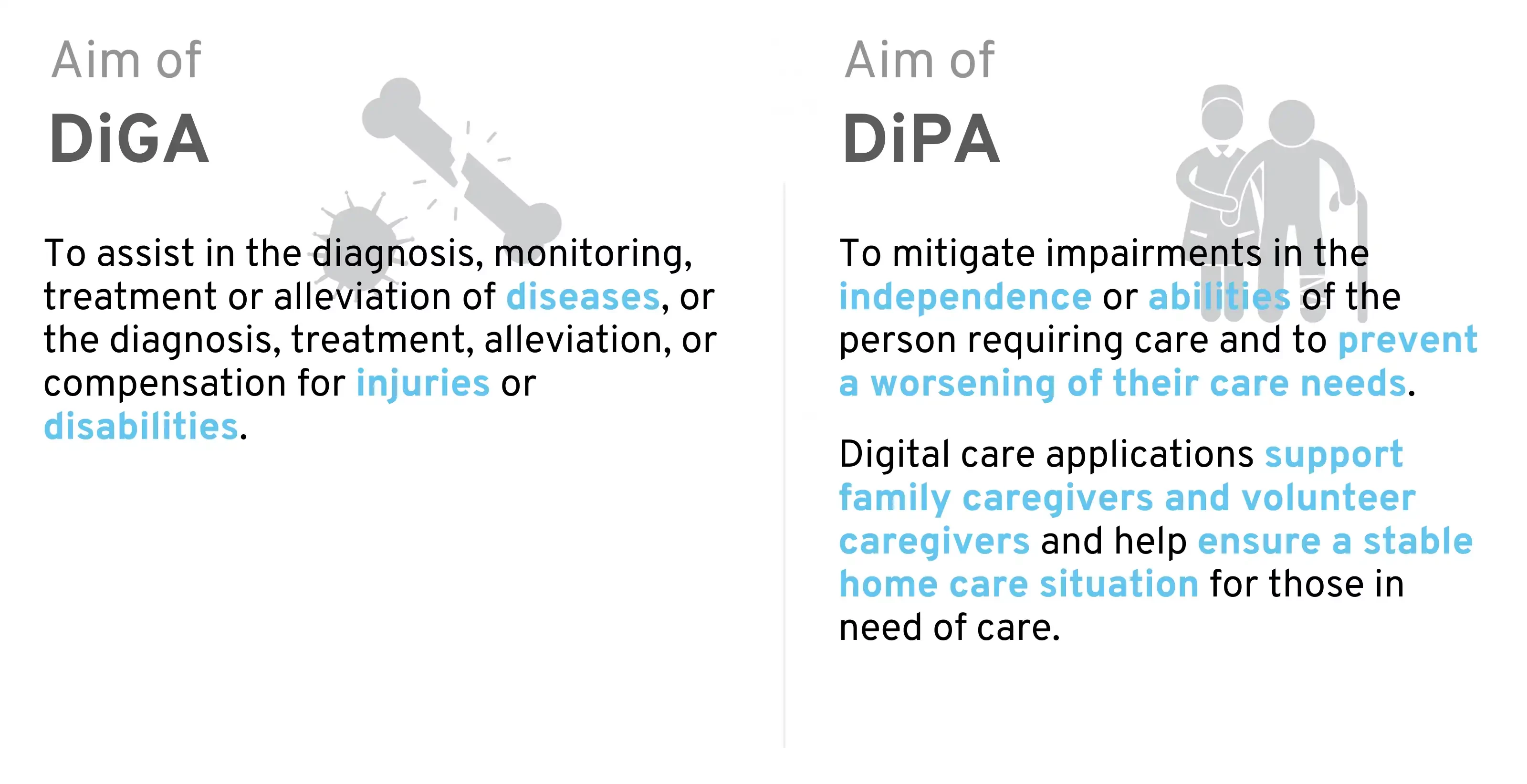
The difference between DiGA & DiPA
Price negotiations with the National Association of Statutory Health Insurance Funds can run in parallel. The entitlement to care starts as soon as the reimbursement has been agreed. It then applies retroactively from the day of inclusion in the directory.
In addition, reimbursement amounts are rising: in future, up to 40 euros per month can be billed for a DiPA. On top of that come up to 30 euros for supplementary services such as training or technical support. People in need of care can therefore receive up to 70 euros per month. The previous limit was 53 euros.
This is made possible by the adoption of the BEEP Act. It was introduced by the current coalition as a successor draft to the Nursing Competence Act, which the previous coalition did not manage to pass, and was adopted by the Bundestag at the beginning of November.
In general, the BEEP Act plans further steps such as reducing documentation obligations, giving nursing professionals more decision-making powers and introducing modern, digitally supported working processes to make everyday nursing more efficient overall. Among other things, relief for family caregivers explicitly counts as a care benefit. The act enters into force on January 1, 2026.
Handelsblatt reports: Neues BEEP-Gesetz soll Zulassung von Pflege-Apps fördern
But will BEEP happen at all?
Despite the positive outlook, there are considerable uncertainties that could jeopardise the entire plan. The BEEP Act is currently hanging in the balance.
As Tagesspiegel reports, the BEEP Act has ended up in the mediation committee, which means it is currently on hold.
This is happening against the backdrop of a complex political landscape, further strained by the unresolved debate about the funding of statutory health insurance (GKV), rising social security contributions and the unresolved pension reform, with direct consequences for the planned reforms in the care sector.
The National Association of Statutory Health Insurance Funds and other players in the care sector are concerned about the delayed decisions. According to experts, further postponement of fundamental progress, such as expanding the competences of nursing professionals and fairer recruitment of trainees, could place an additional burden on nursing staff.
Without a swift clarification of the financial framework for the act, the entire planned relief and the promotion of digital care applications such as DiPA risk stalling.
To the article in Tagesspiegel: GKV-Beitragsdebatte: Es geht ums große Ganze