

With all regulatory parameters fulfilled and entry into the central DiGA directory, are all hurdles cleared and successful market entry guaranteed? Unfortunately, not quite.
Contrary to some wishful thinking, entry into the central DiGA directory itself does not mean that doctors will prescribe your DiGA. Therefore, choosing the right marketing and sales tools is crucial to exploiting the full market potential of the respective niche. The possibilities are diverse and the market environment complex. This article aims to provide you with an overview and helpful classifications.
Overview
- 1. Patient or doctor – two possible addressees who are reached differently
- 2. Different channels are available for different target groups
- 3. Practical example: Fax advertising to medical practices—a prominent DiGA case
- 4. Reception – many paths (do not) lead to the goal
- 5. Understanding the needs of patients and physicians
- 6. Conclusion: Understanding and reaching your target audience is the key to success.
1. Patient or doctor – two possible addressees who are reached differently
The first fundamental question of any marketing strategy is the target group. In the case of a DiGA, two groups come into question:
- Patients who are looking for treatment options in general or a digital application tailored to their own needs in particular, and who can apply for this themselves through their health insurance provider, or
- The physician or therapist who considers the DiGA to be a useful addition to therapy and therefore prescribes it to the patient.
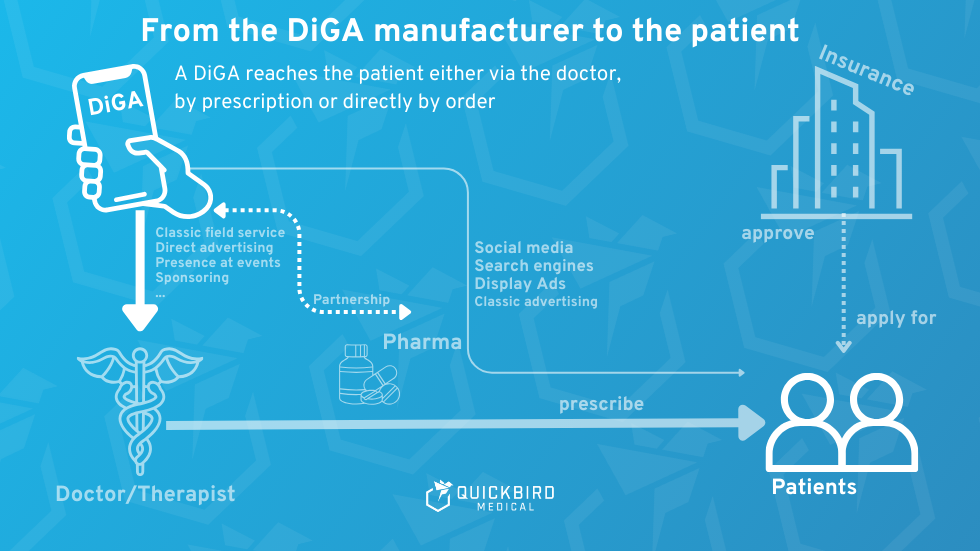
The path from DiGA manufacturer to patient
2. Different channels are available for different target groups
According to Ernst and Young (EY), doctors are the most common prescribers in 90% of cases and, in some cases, are also required to provide an initial assessment. The “balance of power” between the two target groups for DiGA marketing and sales appears clear at this point in time: for most DiGA providers, the sales/marketing focus on doctors as DiGA prescribers will be particularly worthwhile.
Nevertheless, it is worth taking a look at both target groups and their accessibility. This holistic view will be the subject of the following section.
2.1 Marketing for patients as a target group
A DiGA is generally a niche product. As a DiGA provider, you can effectively leverage this clear delineation of the target group(s), particularly through digital advertising.
An overview of possible marketing channels that reach patients directly:
- Search engine advertising and optimization – By optimizing your own websites for visibility in search engines (SEO), but especially by placing paid ads that are displayed to users of major search engines when they search for specific keywords, you can reach a very granularly defined target group in a highly targeted manner. The reach achieved depends primarily on the budget used and can be calculated relatively reliably in advance. On the other hand, the conversion rate, i.e., the (relative) number of purchases actually made from the reach, is rather unpredictable, especially for new products.
In the case of DiGA, this methodology could be used to reach patients who are actively seeking information about their symptoms, diagnoses, and possible treatment options, but who are not necessarily thinking about a DiGA. Keywords such as symptoms and diagnoses could be used here. - Social media marketing – Social media now plays a crucial role as an information and advertising platform. It could therefore make sense to establish a presence here with your own DiGA. In general, the factors for success are an authentic presence, regular content, and choosing the right channels. The chosen platforms must be as well suited to the product and the target group as the type of presentation, the visual language, the wording, and the content. A target group aged 50+ is addressed differently than Generation Z. The content mix for promoting a DiGA could conceivably consist of alternating product information and testimonials or user experiences.
Two social media specialties are also theoretically conceivable as part of the marketing mix: collaboration with influencers (if they can credibly promote the DiGA as part of the target group) and the placement of advertising campaigns. (It should be noted at this point that particular care must be taken when creating advertising materials, texts, etc. that are directly aimed at patients. Since a DiGA is always also a medical device, the German Medicines Advertising Act (HWG) applies here. For example, it must not be suggested under any circumstances that the use of the DiGA will definitely be successful. Excessively sensational wording is therefore also taboo on social media, otherwise severe penalties may be imposed. - Display advertising – Here, freely customizable advertisements are displayed between the actual content on websites that are generally well frequented (e.g. news portals). Here too, most providers (where the choice is greater than with search engines or social media) allow you to filter which people with which interests and which demographic characteristics should see the ad. The costs here also depend on the reach achieved – but the wastage here is relatively high. In the specific case of a DiGA, there is also the fact that it competes with numerous other advertised products for a limited amount of attention.
- Traditional mass media – Of course, digital products can also be advertised in traditional, analog channels (TV, radio, print, etc.). However, there are various points that tend to speak against this approach – in contrast to all digital channels, there is no possibility of filtering the audience in a targeted manner apart from the selection of the medium itself, and there are also no instruments for measuring success and analyzing results. The investment in the production of the media itself (radio spots, TV clips, etc.) is very high, as is the cost of playing them out. On the other hand, there is a high proportion of “dead” reach.
- (Advertising) partnership with health insurance companies – In theory, cooperation with health insurance companies is also a conceivable way of reaching patients directly. After all, they represent the interface between patients and the healthcare system and have a wide-ranging communication network with insured persons. However, it is questionable how they can be persuaded to cooperate: at least the statutory health insurance companies can no longer hope to benefit from advertising for themselves, as they are required by law to reimburse DiGA anyway.
2.2 Sales & Marketing for physicians as the target group
At 90% of prescriptions, the medical profession is a much more important target group. This target group can be reached in particular through channels that differ little from those of traditional pharmaceutical sales in the area of DiGA marketing/sales.
Note: For reasons of readability, the term “doctor” has been used in this text as a synonym for all physicians and therapists who are authorized to prescribe DiGA.
- Direct sales: traditional sales force – Doctors are used to being visited regularly by sales representatives from the pharmaceutical industry. Personal contact with a fixed and physically tangible contact person creates trust and thus a bond. In principle, a DiGA manufacturer can also take this approach to establish an application in the medical profession. Setting up a complete field service network is unquestionably associated with not inconsiderable costs. However, Marcus Bergler, an expert in DiGA sales, has plausibly calculated in his article that it can certainly pay for itself. This sales channel is presumably the one that best suits the medical profession, as they are already familiar with it from the pharmaceutical industry.
- Direct sales: Together with partners – An interesting trend can also be observed in this context: DiGA start-ups are joining forces with pharmaceutical companies in various ways, examples being the collaborations between Kalmeda and Pohl-Boskamp or HelloBetter and Ratiopharm. Pfizer and Roche are also showing great interest in the DiGA market. The existing, established, and widely ramified sales structure of pharmaceutical companies can be used for the distribution of DiGA, and in return, pharmaceutical companies can benefit from the technological know-how of the start-ups. An alternative to this model—for DiGA manufacturers who want to operate independently of the pharmaceutical industry—is mutual cooperation. DiGA manufacturers establish a joint distribution network, thereby sharing costs and risks and ensuring the best possible utilization.
- Classic broad-based advertising – While the “classic” direct marketing described above is probably the central instrument for directly marketing the product, this can be supported by accompanying measures with the purpose of increasing awareness and general image building. Classic means here are, for example, advertisements or, ideally, achieving “real” coverage in specialist media as well as sending brochures specially designed for the medical profession to practices with a relevant focus. As in other industries, events are also regularly held for doctors. Depending on the format, it may make sense to show your presence with a stand and/or a specialist lecture, for example.
- Sponsorship of continuing education – A more subtle measure to increase awareness can be sponsorship: Every specialist is required to earn 250 so-called CME points within five years. The corresponding training courses are often offered free of charge and are financed, among other things, by sponsors, e.g., pharmaceutical manufacturers. Even though sponsorship must not influence the content of the training course in any way, the sponsor still gains a certain presence at the event, whether through the mention and positioning of their name or logo or through the display of promotional items. There are already CME training courses specifically on the topic of DiGA. It may be even more effective to sponsor training courses that deal with the clinical picture addressed by DiGA. Such a measure provides access to an audience that is professionally affected by DiGA and, at the same time, may be hearing about it for the first time through the sponsorship.
Note: The list of distribution channels mentioned is certainly not exhaustive and is primarily intended to give you an initial overview of some possible measures. You should also consider other channels that are not explicitly mentioned here.
3. Practical example: Fax advertising to medical practices—a prominent DiGA case
A highly publicized case from the DiGA market concerns a manufacturer of an obesity DiGA who used a targeted marketing tactic: patients who showed interest in the DiGA were actively encouraged by the manufacturer to give him power of attorney to contact their treating family doctor’s office. On this basis, the manufacturer sent a fax to the doctor to initiate the issuance of a prescription or a short certificate.
The fax contained a cover letter, a form for a brief assessment (in which the DiGA was already pre-entered), and a form for requesting further information about the DiGA free of charge. In addition, the manufacturer pointed out billable medical services in connection with the use of the DiGA. The approach proved to be very effective and led to a high number of prescriptions in the short term.
However, this distribution channel is not legally permissible. In its ruling of November 18, 2025 (Ref. 6 U 130/24), the Higher Regional Court of Brandenburg clarified that this constitutes impermissible advertising by fax pursuant to Section 7 of the German Unfair Competition Act (UWG), as the physician had not consented to such advertising. The decisive factor was that the fax went beyond a neutral forwarding of the patient’s request and contained specific sales promotion elements.
This case shows that even highly effective marketing tactics initiated by patients come up against clear legal limits when it comes to DiGA distribution.
4. Reception – many paths (do not) lead to the goal
It is not unlikely that the topic of DiGA is new territory for the doctor in question. According to a 2021 survey by the Fraunhofer Institute, “75% of participating doctors rate their level of information about DiGA as poor or very poor.” The need for information and interest is correspondingly high: in the same survey, 37% of doctors stated that they were “very willing or extremely willing” to prescribe DiGA. However, according to their own statements, only 2% have done so to date. Nevertheless, as mentioned above, prescriptions by doctors account for 90% of the total market.
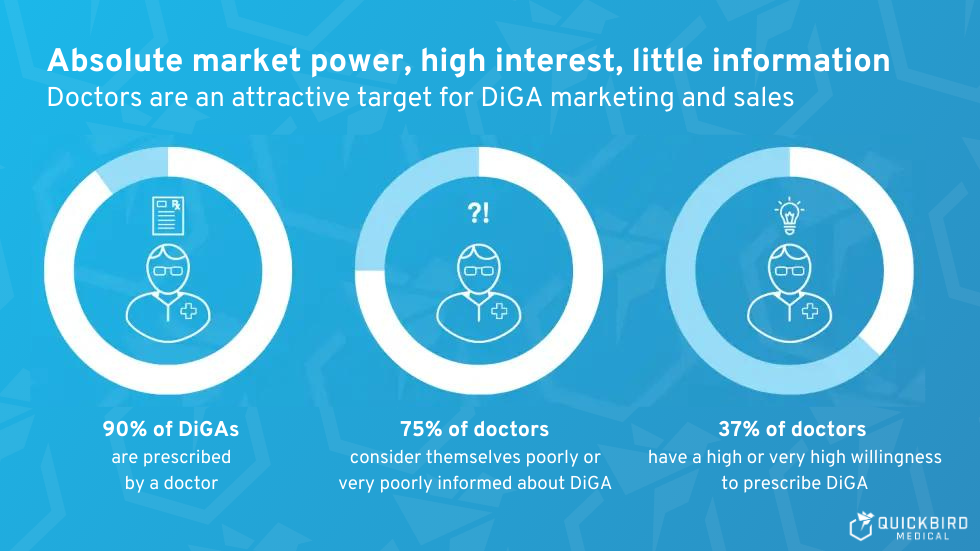
Doctors are an attractive target for DiGA marketing
Low level of information, high level of interest, absolute market power: the medical profession as a target group is therefore the “low-hanging fruit” that needs to be harvested as a first step after entering the market. The most obvious and promising step is to seek direct contact. If you as an individual DiGA manufacturer cannot or do not want to do this alone, it makes sense to cooperate with pharmaceutical companies or other DiGA manufacturers. This can be accompanied by various measures to increase awareness: advertising campaigns, presence at congresses and events, or sponsorship of relevant training courses.
With increasing health awareness in society on the one hand and growing familiarity with digital technologies on the other, it is conceivable that this will change rapidly. This may be induced by marketing and sales activities on the part of the DiGA manufacturers themselves. Almost the entire range of product advertising is available for marketing a DiGA directly to patients. Given the very clear demarcation and the assumed digital affinity of the target group(s), digital forms of advertising appear to be particularly meaningful. The risk here is also lower, as there are no fixed costs.
5. Understanding the needs of patients and physicians
In addition to choosing the right channels, another key to successfully defining your own marketing strategy is choosing the right content. Understanding the mindset and needs of your target groups is important for both. “The success of digital transformation in healthcare depends on the extent to which patients, insured persons, and service providers accept digital solutions,” states the Bertelsmann Foundation.
The market must “demand” the corresponding DiGA. The target group “patients” must be one that faces a health challenge with a high level of individual suffering and, at the same time, limited treatment options. DiGA marketing can and must “pick up” patients at these points and make it clear to them that DiGA offers an unconventional method that, at best, can be integrated into everyday life in an extremely user-friendly way. Our guide will show you how to define your target group in a targeted manner and demonstrate a positive effect on care.
For the target group of “medical professionals,” it is important that the DiGA is proven to “work.” Doctors also listen to the feedback that patients provide after using it. If the patient is not convinced by the DiGA or does not use it, the likelihood of follow-up prescriptions drops dramatically.
6. Conclusion: Understanding and reaching your target audience is the key to success.
The variety of conceivable marketing and sales channels is enormous. This can make it particularly difficult at the beginning to decide on a starting point, a strategy (and, ideally, the “right” one).
However, it is also clear that there can be no universal recommendation for action. Every DiGA is a unique product in a unique and complex market environment. For a successful market launch, it is essential to analyze this environment in detail and, based on this analysis, select the marketing and sales methodology that best suits the product and target group.
Are you still in the early stages? Find out which factors you should consider when planning and implementing your DiGA in our white paper “13 Recommendations for DiGA Approval in 2026.”
With this article, our goal was to provide you with a broad overview of possible instruments and, in keeping with the nature of a blog article, to classify them in general terms.
About us: QuickBird Medical specializes in implementing DiGA on a contract basis. If you are planning a DiGA, please feel free to contact us at kontakt@quickbirdmedical.com.