
Digital Health Technologies in Clinical Trials: We Develop Study Apps and Software for Wearables
We develop digital health technologies (DHTs) for clinical trials: study apps that integrate smartwatches and sensors and capture data directly in participants’ everyday lives, plus the data platform behind them. Aligned with the expectations of the US Food and Drug Administration (FDA) and the European Medicines Agency (EMA): verified, validated, tested for usability and with a traceable data chain. Certified to ISO 13485 and ISO 27001.





















What we develop for your study with digital health technologies
A DHT consists of hardware, such as a wearable or sensor, and software, or sometimes of software alone, such as a study app. We develop your entire DHT, meaning study app, device integration and data platform, or support your team with individual components. We select the right hardware with you and integrate it.

Study apps and active tests
Apps for iOS and Android with active tests, such as gait tests or cognitive tasks, and electronic patient-reported outcome (ePRO) questionnaires. Including usability testing with the target group according to IEC 62366, so that the trial population can use the app without errors.

Integrating wearables and sensors
Integration of wearables, sensors and medical devices via Bluetooth or through the manufacturers’ interfaces. On participants’ own smartphones and on devices provided for the study, so that no one is excluded, as the FDA and EMA expect.

Data platforms and EDC integration
Backend and dashboards that store every measurement with a timestamp and device information, as set out in the EMA guideline on computerised systems. With an audit trail, aligned with the FDA regulation on electronic records (21 CFR Part 11), and transfer to your electronic data capture (EDC) system or study database.

Verification and validation
We test the entire data chain from sensor to export, documented within our ISO 13485-certified quality management system. The EMA requires validation for every system used in the trial, and the FDA explicitly expects verification and validation even if the DHT is not a medical device. If an algorithm has already been validated, we integrate it unchanged.

Maintenance and updates during the study
On request, we operate and maintain the software during the study. We test new operating system versions before participants use them. This keeps the DHT fit for purpose after updates, as the FDA and EMA expect.

Medical device approval
Is your DHT a medical device? We clarify its intended purpose and risk class under the EU Medical Device Regulation (MDR) and its device classification for the FDA. If required, we take on the role of legal manufacturer under the MDR.
What are digital health technologies?
The FDA defines a digital health technology (DHT) as follows:
“A digital health technology (DHT) is a system that uses computing platforms, connectivity, software, and/or sensors, for health care and related uses.”
FDA, Digital Health Technologies for Remote Data Acquisition in Clinical Investigations, Section I (2023)
In other words, any technology that captures health data digitally: wearables, sensors and software such as mobile apps. According to the FDA, the spectrum ranges from general wellness products to medical devices.

In clinical trials, one thing matters most: DHTs measure in participants’ everyday lives, not just during visits to the study site.
For raw data from a DHT to become a usable measurement, software is needed: the device measures in everyday life, and an algorithm filters the signal and calculates the value for the study. If it is established that this value reliably relates to an accepted clinical measure, it is called a digital biomarker.

Reference projects
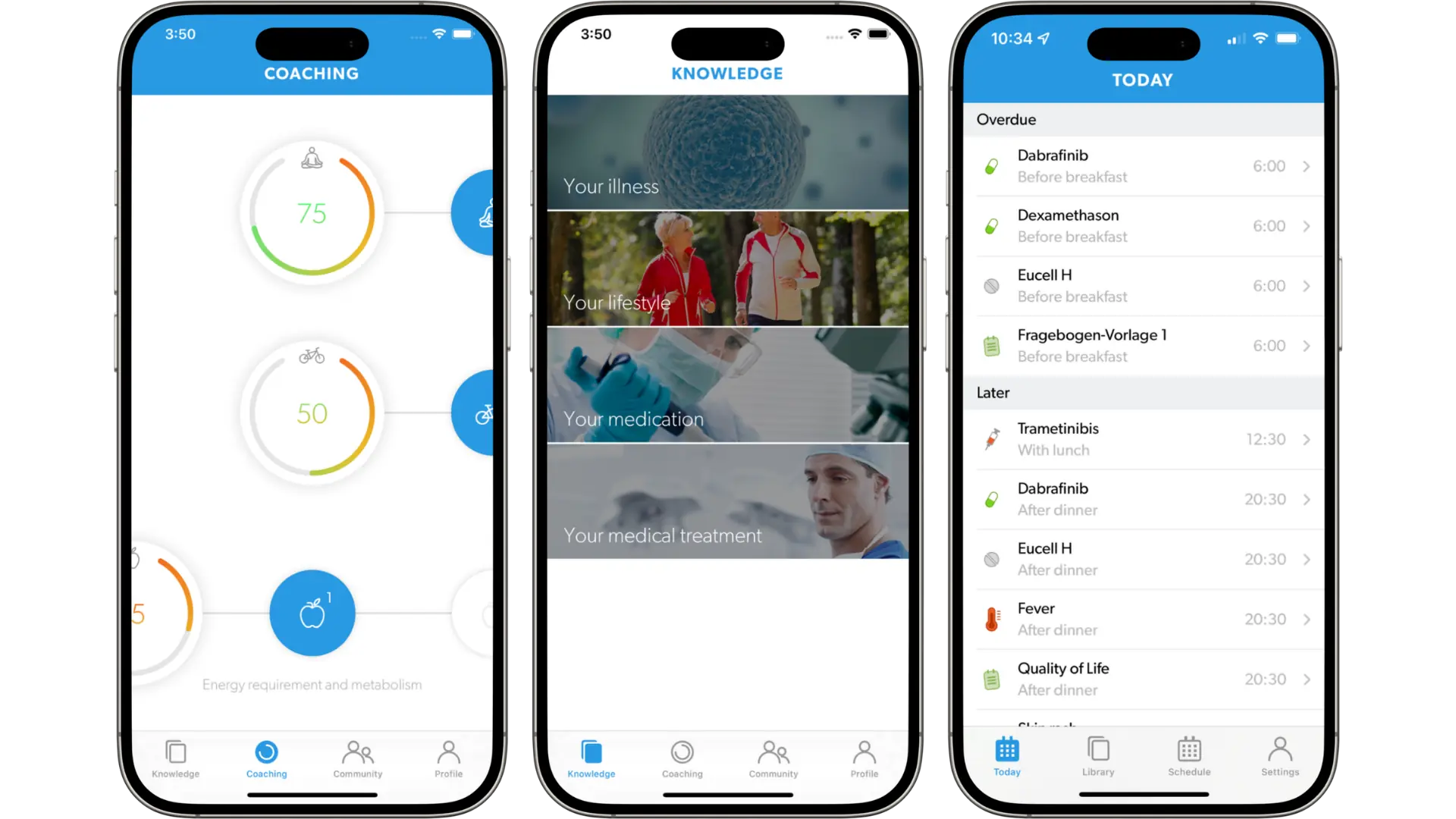
CardioCare
Integration of FDA-cleared sensors
An app for patients with cardiovascular diseases that integrates several wearable sensors. We developed it and brought it to market as a medical device in five languages.
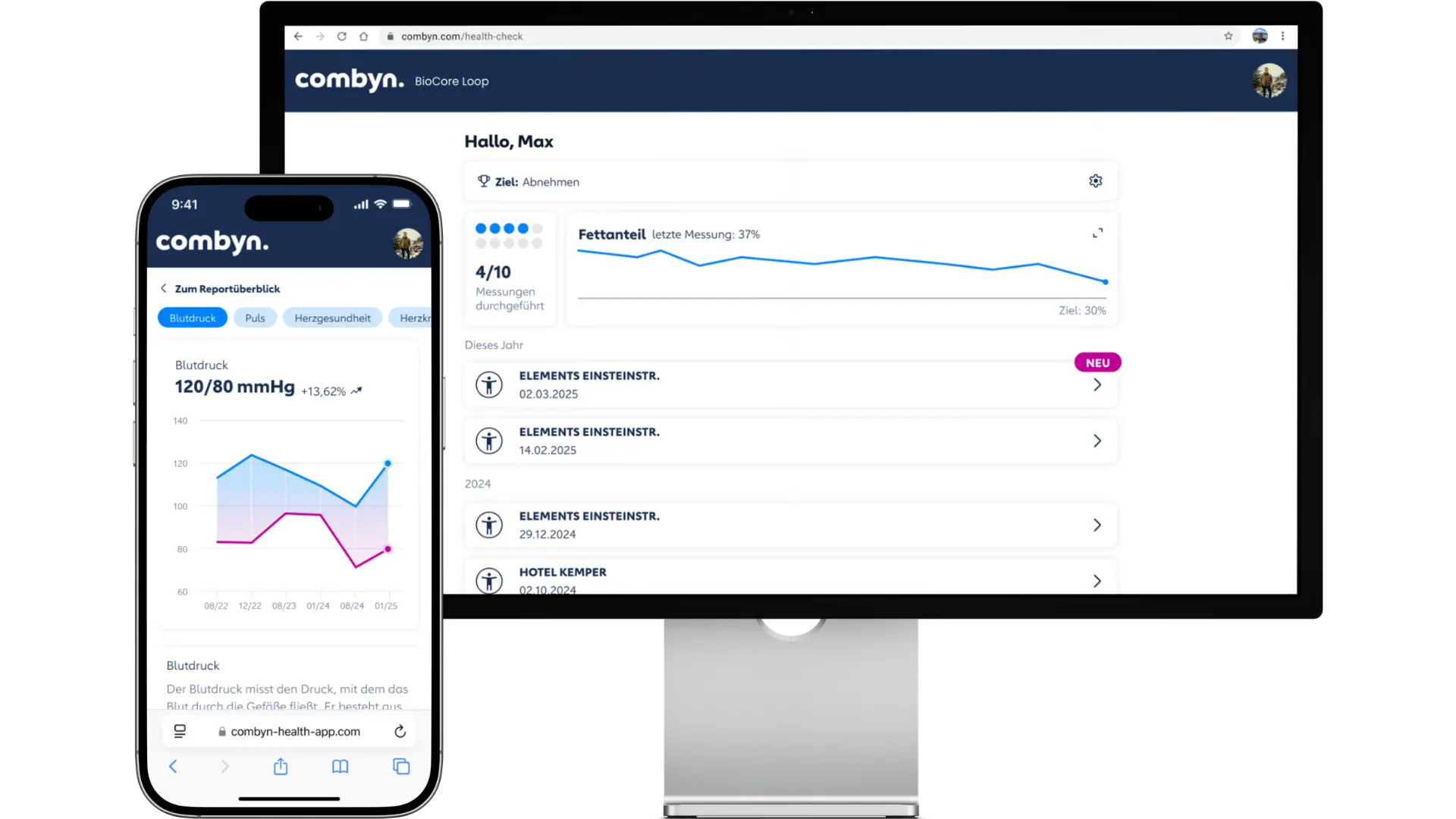
Combyn
On-device signal processing according to IEC 62304
For an autonomous health terminal that measures ECG and bioimpedance, we developed the embedded software, backend and web platform in line with the requirements for a class IIa medical device under the MDR.

Swiss Cannabis Research
Study platform with ePRO
We developed the study platform with onboarding, electronic questionnaires and randomisation, for several thousand participants in Switzerland’s largest cannabis pilot study. The study has been running since May 2024.

The product can be connected to several FDA-cleared wearable sensors.
“The product can be connected to several FDA-cleared wearable sensors, which enables the capture of digital biomarkers as part of clinical studies. We are extremely satisfied with the result and look forward to a continued successful collaboration.”
What sets us apart

ISO 13485 certified
Our quality management system is certified to ISO 13485. This ensures compliant development of software as a medical device and takes into account the requirements of the MDR and the FDA (21 CFR) for quality management systems.

ISO 27001 certified
QuickBird Medical is certified to ISO 27001 for information security. We are experts in cybersecurity and data protection for health data.

Legal Manufacturer
If required, we take on the role of legal manufacturer for your medical device software. We thus bear the legal responsibility for compliance with all regulatory requirements of the MDR. This lets you focus on your core competencies.
Frequently asked questions about digital health technologies
Does a DHT in a US trial have to be an approved medical device?
Not necessarily. According to the FDA guidance, devices used in a clinical investigation are exempt from most requirements that apply to medical devices, including marketing authorization, as long as the investigation complies with 21 CFR Part 812. If a DHT is used only in the trial and the recommended verification and validation activities have been carried out, the FDA does not intend to separately assess compliance with design control requirements.
Is a DHT a medical device in Europe?
That depends on its intended purpose. What counts is the definition of a medical device in Article 2(1) MDR. For software and apps, the Medical Device Coordination Group’s guidance MDCG 2019-11 explains how to apply this definition. If a medical device without CE marking or outside its intended purpose is used in a clinical trial of a medicinal product, national authorities have so far taken different approaches to the documentation required. We therefore clarify at the outset which rules apply in your trial countries.
Sources: MDCG 2019-11 · Position paper by the European Federation of Pharmaceutical Industries and Associations (EFPIA)
Can trial participants use their own smartphones?
Yes, both the FDA and the EMA allow this. However, both expect that no one who lacks a suitable device or does not want to use their own is excluded. In practice, this means the same app on participants’ own devices and on devices provided for the study, with defined minimum requirements and a plan for operating system updates.
Which data count as source data for a DHT?
For the FDA, source data are the data first stored in a durable electronic data repository. The EMA sees this differently for electronic questionnaires: there, the data on the device are source data, and after validated transfer the data on the server are certified copies. We therefore define at the outset where the source data originate and build the data chain accordingly.
Sources: FDA guidance (PDF), Section IV.G · EMA guideline on computerised systems (PDF), Annex A5.1.1.2
Planning a study with digital health technologies?
We develop your DHT, from selecting the technology to operating it during the study, aligned with the expectations of the FDA and EMA. Get in touch and arrange a no-obligation initial consultation.