
AI-supported care program for endometriosis
Summary
ENDO-EVE
Endometriosis is one of the most common gynecological conditions, affecting around one in eight women. Even so, it often takes up to 10 years to reach a diagnosis, because period pain is frequently dismissed as “normal.” For those affected, this means years of pain, fatigue and reduced quality of life.
ENDO-EVE addresses exactly this. The cross-sector care program connects gynecology practices with the endometriosis centers at University Medicine Halle and at the University Hospitals of Heidelberg and Tübingen. Patients with suspected endometriosis are recorded in a structured way at the practice, assessed using a risk score and referred to a center in a coordinated manner.
At the center, this is followed by a digital education and therapy program that supports them for twelve weeks and beyond. The project runs until February 2029 and follows around 2,000 patients as part of the evaluation.
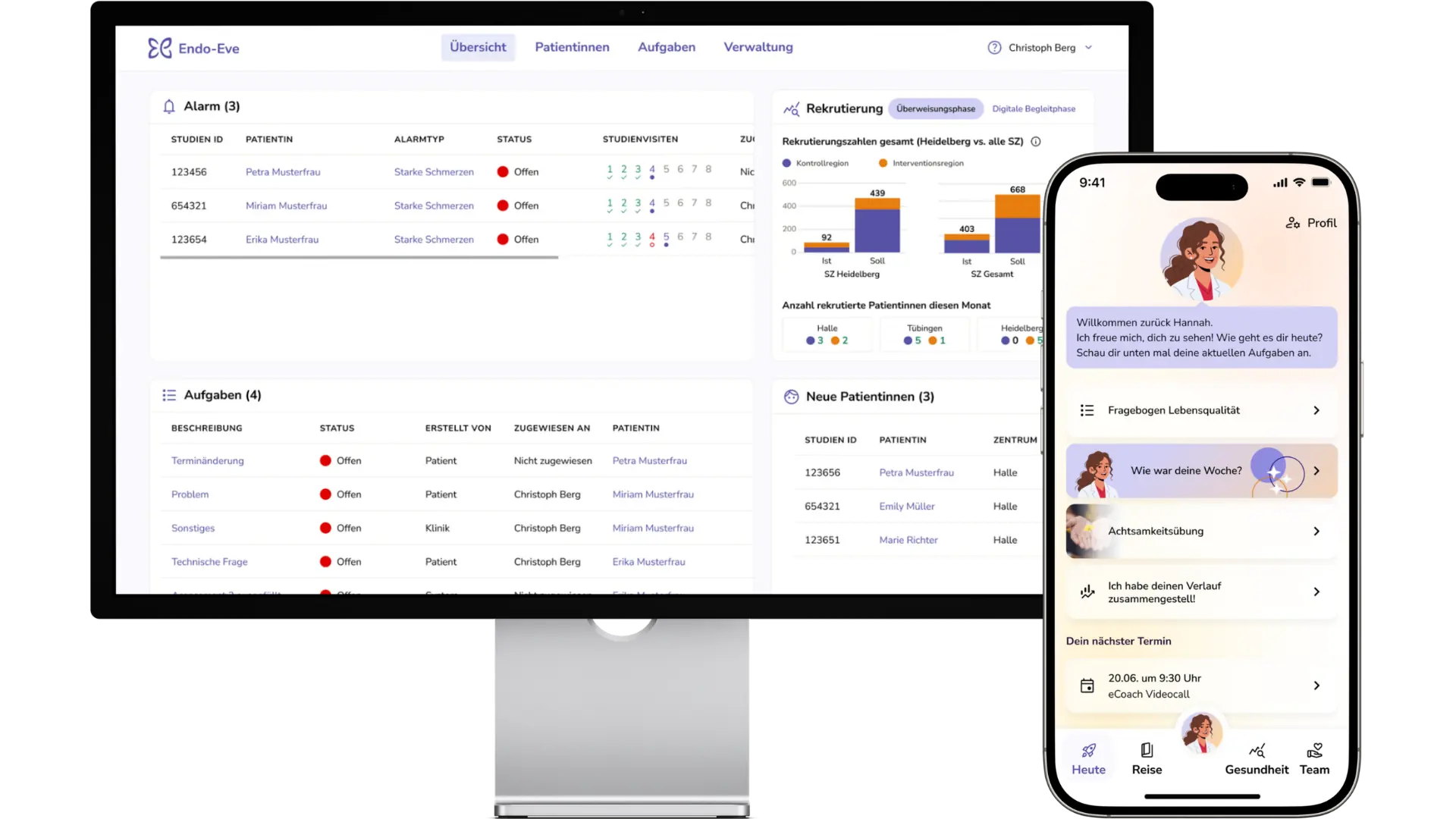
For the digital part of the program, QuickBird Medical was the main development partner and developed the mobile app for patients, the care portal for physicians and eCoaches and the associated cloud infrastructure. The development work also included the program’s AI components and the UX/UI design for both user groups. This is complemented by operation, support and maintenance within the scope of the agreed services.
Challenge
Two user groups with different requirements had to come together in one system. Patients should stay motivated over six months, while the additional effort for the treating clinicians should be kept as low as possible. At the same time, the reliability of the software is essential for the scientific evaluation: ENDO-EVE is designed as a randomized study, and technical problems can affect participation, the completeness of the data and therefore the ability to analyze the data. Stability and data integrity are therefore key requirements.
A particularly demanding part was the AI component. It is intended to analyze the information provided by patients and derive individually suitable therapy content from it. Medical statements and recommendations for action must be based on reviewed content and defined rules. Especially for a condition about which a great deal of misinformation circulates, a medically controlled and traceable design is crucial. This applies both to the treating professionals and to the scientific evaluation.
Process
QuickBird Medical was chosen over several other providers in a selection process run by the consortium. From September 2025, development followed an agile approach across eight milestones, carried out by an interdisciplinary team covering project management, mobile and web development, design and quality assurance, entirely from Munich and without outsourcing. We worked within our quality management system certified to ISO 13485 and our information security management system certified to ISO/IEC 27001, and were guided by the software life cycle according to IEC 62304.
One focus was the implementation of the AI-supported features. The solution combines structured information provided by patients with a curated medical content library to deliver individually suitable therapy content. In addition, automated progress monitoring supports the detection of worsening symptoms and the involvement of the care team in accordance with the designated processes. It was crucial that medical recommendations remain controlled and traceable. In parallel, we developed a stigma-sensitive design for a condition that is often treated as taboo and tested the solution with the centers in a pilot phase.
Result
The result is an integrated platform made up of three building blocks. The patient app runs on iOS and Android and includes several therapy modules, practical exercises, a cycle and pain diary, care plans and regular patient-reported outcome (PRO) assessments. The care portal is the working environment for study centers, physicians and eCoaches. It supports the structured workflows for managing the study and supporting its participants, and allows treatment courses to be viewed within the designated access rights. If symptoms worsen, defined notifications and measures can be triggered so that further care can proceed according to the processes stored in the system.
Both applications use a shared cloud infrastructure that we developed and operate, including a content management system for the medical content. The pilot has started, and the solution has been in use with patients at the study centers since May 2026.
The QuickBird Medical team really impressed us on the technical and regulatory side and in implementing the AI features.
“ENDO-EVE is a consortium project involving several partners. In Halle, we work with QuickBird Medical on the technical implementation. QuickBird Medical built the app for patients, the portal for care teams and the technical platform behind them.
The project is technically demanding: multiple sites, ongoing study operations and the requirements for a medical device. For this, QuickBird also took on quality management in accordance with ISO 13485 and the technical documentation. Whether and to what extent the program improves care is being scientifically evaluated as part of the Innovation Fund project.
The QuickBird Medical team really impressed us on the technical and regulatory side and in implementing the AI features. We are very happy to continue working together.”
Future
Within the scope of the agreed services, we are providing operation, support, security, maintenance and upkeep for ENDO-EVE until the end of the project term in February 2029. During further recruitment, follow-up and evaluation, a stable and reliable platform is essential so that the collected data can be scientifically analyzed.
The actual long-term goal lies beyond the study. If the evaluation is positive, new forms of care are intended to find their way into standard care. The platform was developed with scalability and maintainability in mind, in order to allow, in principle, later use beyond the project as well. Whether and in what form this happens depends on the results of the evaluation and the subsequent decisions of the consortium.