
The Digital Healthcare Act (DVG) for “better care through digitization and innovation” (translated from German) came into force on December 19, 2019. The aim of the DVG is to enable patients to have health applications prescribed by their doctor, make telemedicine more accessible, and promote digital innovation. The DVG also initiated the introduction of electronic patient records (on the telematics infrastructure) in January 2021.
In this article, we explain what is meant by “doctors can prescribe apps” and, specifically, how software manufacturers can have their apps or software prescribed. The DVG not only makes financing apps easier, but is also intended to significantly speed up the negotiation process with health insurance funds.
Table of contents
- 1. Prescribing apps
- 2. Accelerated market launch
- 3. Criteria for inclusion in the directory of digital health applications
- 4. Conclusion
1. Prescribing apps
Basically, we are not talking about apps, but about health applications in general. These are medical devices that use digital technologies to support the detection, monitoring, treatment, compensation, or alleviation of diseases, injuries, or disabilities. These include, for example, apps that help diabetes patients document their blood sugar levels or apps that remind their patients to take their medication.
Patients will be able to obtain such applications in the future through a prescription from their treating physician or with the approval of their health insurance fund. The app manufacturer will receive appropriate financial compensation for this.
To do so, however, the app manufacturer must first submit its app to the BfArM (Federal Institute for Drugs and Medical Devices) for review. If the BfArM approves, the app will be covered by statutory health insurance for a provisional period of one year. Once a positive healthcare effect has been demonstrated, the GKV-Spitzenverband (National Association of Statutory Health Insurance Funds) will negotiate with the manufacturer to determine the amount of reimbursement by the health insurance funds. Prior to permanent inclusion, the prices set by the manufacturer apply.
2. Accelerated market launch
Another important point is the accelerated market launch: The BfArM decides on the application within three months of receiving the complete application documents. If the BfArM accepts the application/app, it is added to the DiGA directory (digital health applications).
Once the app has been permanently included in the directory, negotiations with the GKV-Spitzenverband (National Association of Statutory Health Insurance Funds) begin to determine the reimbursement amount. Here, too, there is a clear timeline: if no agreement is reached within six months of the start of negotiations, the arbitration board will determine the reimbursement amounts within three months.
If the health application meets all criteria, the way is clear for a rapid market launch. This makes it easier for startups in particular to enter the already difficult healthcare market.
3. Criteria for inclusion in the directory of digital health applications
If the BfArM accepts the application/app, it is added to the DiGA directory (digital health applications). According to the BfArM, the application must meet the following criteria, among others, in order to be included. All details of the procedure, including the exact criteria for inclusion in the DiGA directory, are set out in a supplementary statutory ordinance. This ordinance is called the DiGAV (Digital Health Applications Ordinance). We have written a comprehensive guide to the DiGAV here. Here is a rough overview:
#1: The application must be a low-risk medical device (Class I or IIa) and have successfully completed a conformity assessment procedure in accordance with MDR (Medical Device Regulation) or MDD (Medical Device Directive).
This criterion is very clear and compliance is specifically regulated by the MDR and MDD. We explain how you can decide whether your application is a medical device in a separate article. If you already know that it is a medical device, you can find its risk class using our MDR guide.
#2: Positive healthcare effects must be demonstrated through the application.
The DiGA must demonstrate positive healthcare effects. If the manufacturer is initially unable to demonstrate any positive healthcare effects, it can still apply for the digital health application to be included in the DiGA directory for testing. With sufficient justification, this period can be extended by up to 12 additional months. More information on this can be found in our guide to the DiGAV.
#3: The application is tested for safety, functionality, and quality.
Since the application must be a medical device, this criterion will naturally be met. There is currently no better proof of safety, functionality, and quality for health applications than the Medical Devices Act/Medical Devices Regulation.
#4: The application must ensure data security and data protection.
A fundamental distinction is made between data security and data protection. Data security refers to technical safeguards for protecting data (against viruses, manipulation, hackers, etc.). Data protection describes how personal data can be processed in order to protect it from misuse (regulated by law).
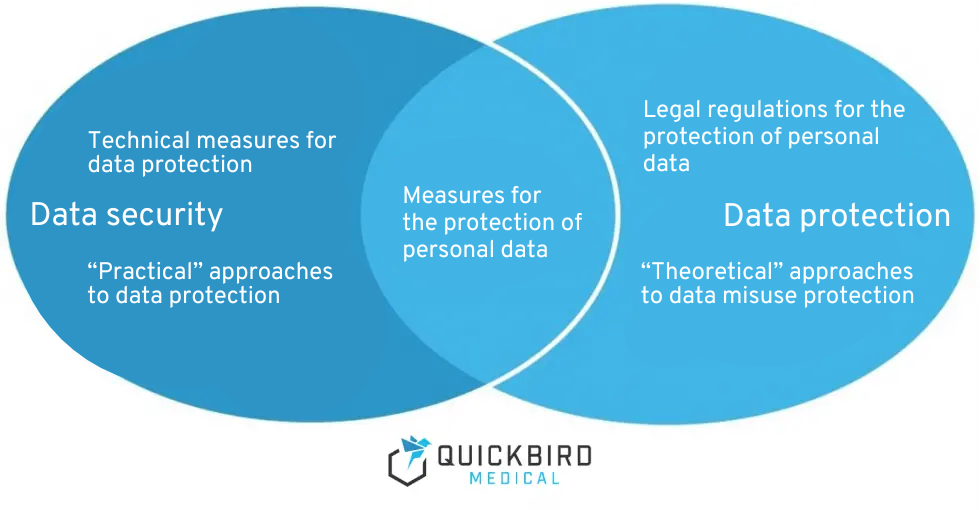 Requirements for data security and data protection for DiGA
The Medical Devices Act and the GDPR already set out requirements for data security and data protection. The BfArM also uses a questionnaire to ask for specific details, as can be seen in the DiGAV. From 2022 at the latest, certification in accordance with the ISO 27000 series will even be required. From 2023, all DiGA (including those already listed) must have a data security certificate from the BSI and a data protection certificate. Find out more in this article: Data security and data protection certificates for DiGA
In addition to the criteria mentioned above, there are several other conditions that we will not explain in detail here. You can find a complete list of all criteria in our article on the topic “Is your app a DiGA?”
If the application meets all criteria and is accepted by the BfArM, statutory health insurance funds will reimburse the costs of the application for one year. During this period, the manufacturer must demonstrate whether its app improves patient care. At the end of the year, an evaluation is carried out to determine whether the application will remain in the DiGA directory or not. In principle, the BfArM also advises companies on inclusion in the DiGA directory (subject to a fee).
4. Conclusion
The DVG is an important step toward enabling continuous innovation in the healthcare sector in Germany in the future. The specific provisions are a long-overdue step toward advancing the digitization of the healthcare system.
This will not only facilitate the market launch of health apps, but also accelerate it. This will enable more companies to bring innovative digital products to market.
Of course, not every health app is useful. It is therefore important to question the benefits of each health application. Health insurance funds should not be expected to pay for applications that offer no added value for patient treatment.